Aston Villa Finances 2024/25Swiss Ramble
I Love The Sound Of Breaking Glass
This has the makings of another fine season for Aston Villa, as they are on course for fourth place in the Premier League, while they have secured their qualification for the Champions League.
In addition, they could get their hands on some silverware by winning the Europa League, as they are favorites to beat German side Freiburg in this week's final in Istanbul.
Poor Start to the Season
There had been concerns amongst Villa fans at the beginning of the season, after the club failed to win any of their first five league games. This came on the back of the announcement that Monchi, the president of football operations, and more importantly a close confidant of head coach Unai Emery, would be leaving.
However, the team has once again done the business under Emery. Indeed, Villa have finished lower than seventh under the Spaniard since he replaced Steven Gerrard in October 2022.
Most impressively, Villa have now qualified for Europe's premier competition twice in the last three seasons - and only missed out on goal difference last year.
League Position
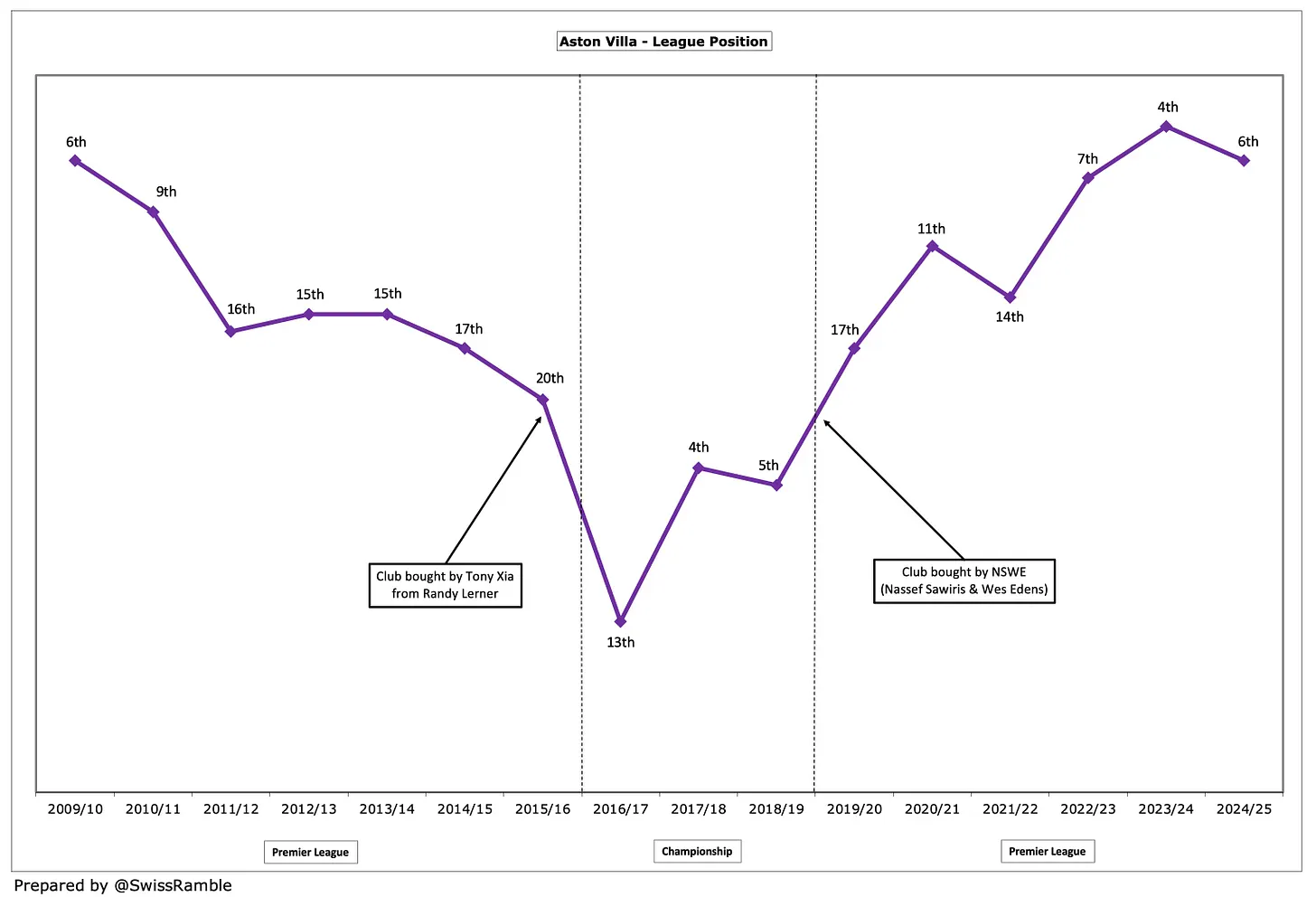
It bears remembering how far Villa have progressed under owners Nassef Sawiris and Wes Edens, who bought the club in July 2018.
They have invested big money in order to compete with the traditional elite, which is reflected in the club's financials, but in addition it “has made significant progress against its stated objective of delivering sustainable improvement on and off the pitch.”
Villa were languishing down in the Championship just seven years ago, while they were even close to going out of business before their victory against Derby County in the play-off final.
Francesco Calvo, Villa's President of Business Operations, expanded on this point, “Until three and a half years ago we were fighting to avoid relegation, but now we're establishing ourselves at the top of European football.”
PSR Restrictions
However, Villa have had to contend with restrictions imposed by PSR, which represents a major challenge for aspirational clubs. Indeed, Sawiris said that the rules “do not make sense and are not good for football”, even going as far as describing them as “anti-competitive”.
Arguably, Villa have been victims of their own success, as qualification for Europe brings with it the need to comply with UEFA's financial regulations, which are much tougher than those applied in the Premier league.
in fact, Villa failed to comply with both of UEFA's rules (football earnings and squad cost), which resulted in a couple of fines, as well as a settlement agreement.
They also faced a restriction on transfers, whereby they “may not register any new player on their List A to UEFA club competitions unless the List A transfer balance is positive.”
Transfers 2025/26
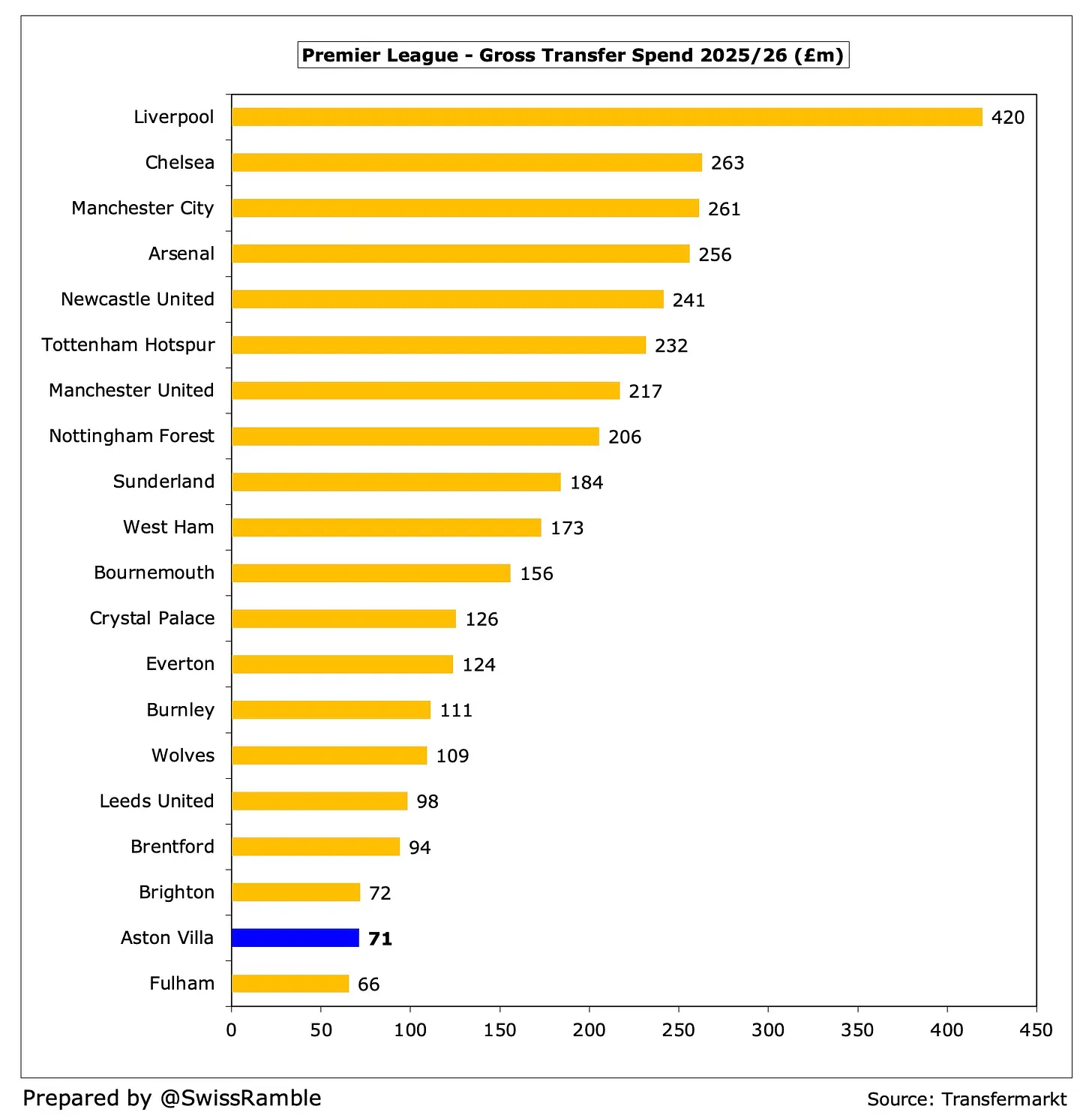
This clearly impacted Villa's ability to strengthen the squad this season, as their £71m gross transfer spend was the second smallest in the Premier League, only ahead of Fulham.
In stark contrast, no fewer than eight of their rivals splashed out more than £200m, led by Liverpool £420m, Chelsea £263m, Manchester City £256m and Arsenal £256m.
The only major signing last summer was Evan Guessand from Nice, although Tammy Abraham (Besiktas) and Alysson (Gremio) were added in the January window. They were supplemented by the free transfer of Victor Lindelof plus loan deals for Jadon Sancho and Harvey Elliott, although it felt like Villa were shopping in the bargain basement.
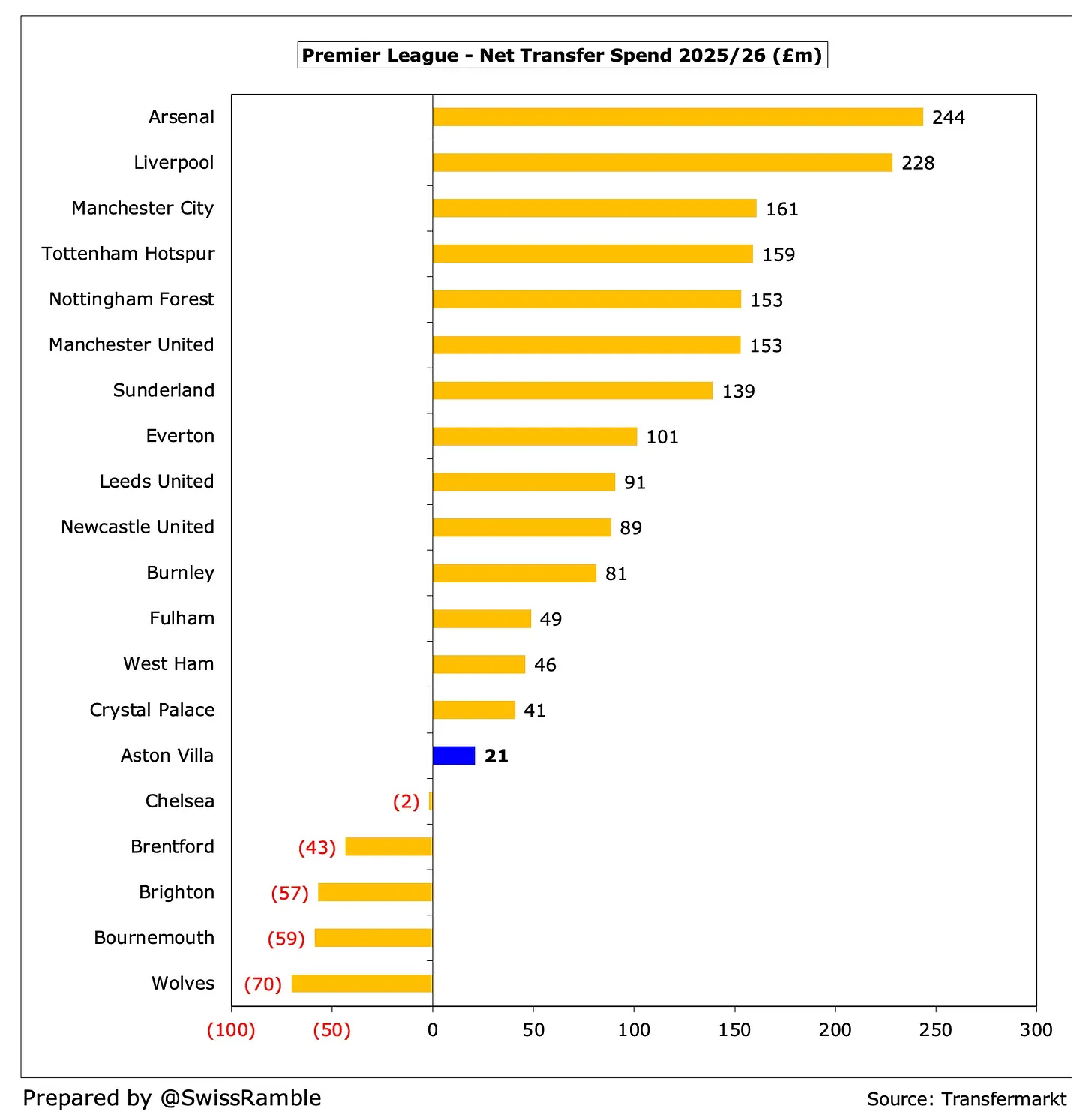
Furthermore, net spend was a lowly £21m, as Villa were effectively forced to offload Jacob Ramsay to Newcastle United to comply with the financial restrictions, especially as the sale of the Academy product delivered “pure profit”.
They also failed to secure the signing of Conor Gallagher from Atlético Madrid, after they were outbid by Tottenham, while they could have done without losing Donyell Malen to Roma on loan in January.
So what exactly is Villa's financial position?
Although now almost a year out-of-date, the 2024/25 accounts provide a decent view of Villa's strengths and weaknesses.
2024/25 Season
These covered another successful season when the club finished sixth in the Premier League, while Champions League football returned to Villa Park for the first time since the 1982/83 season, with Villa reaching the quarter-finals of the tournament, before being narrowly defeated by the eventual winners Paris Saint-Germain.
In addition, they reached the semi-finals of the FA Cup, where they were beaten by Crystal Palace, with the Eagles also eliminating Villa in the fourth round of the Carabao Cup.
13th Month Impact
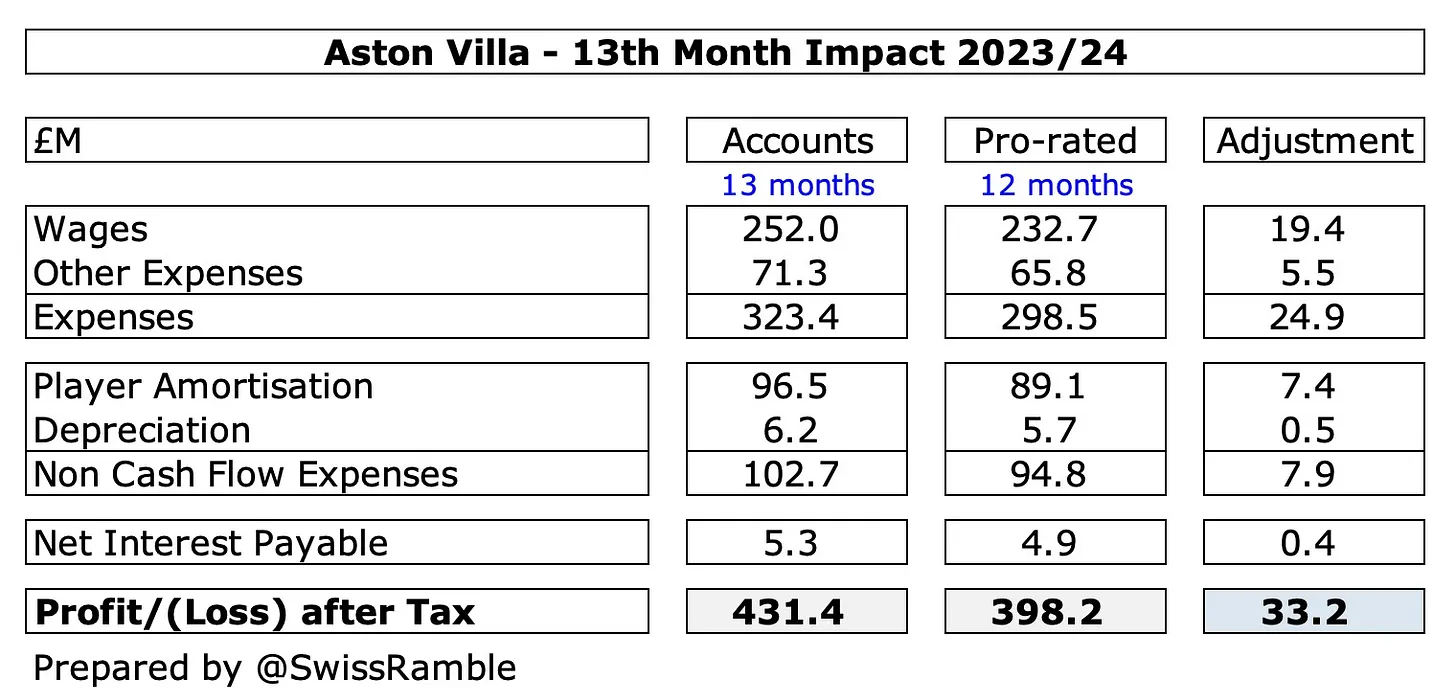
Before we start delving into the club's finances, it's worth noting the technical impact of the change in the year-end from May to June in 2023/24, which means that those accounts covered 13 months, compared to the usual 12 months last season.
This change resulted in an additional month of expenses, while there was little impact on revenue, as there were no matches played in June.
This factor should be borne in mind when looking at Villa's comparatives against the previous year, as it led to expenses being £33m higher (on a pro-rated basis).
Therefore, the underlying year-on-year expenses growth would have been even higher than shown in the accounts.
Profit/Loss 2024/25
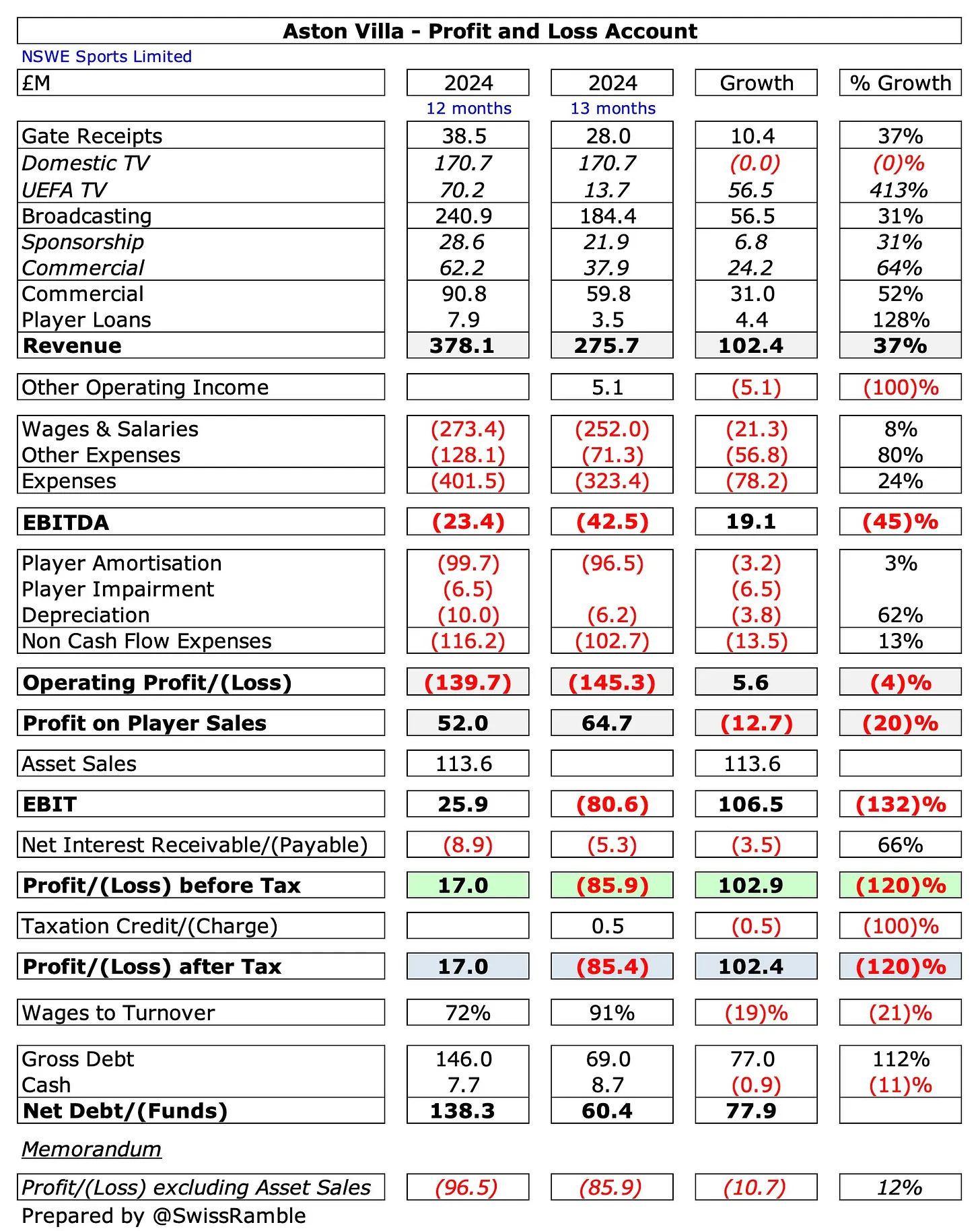
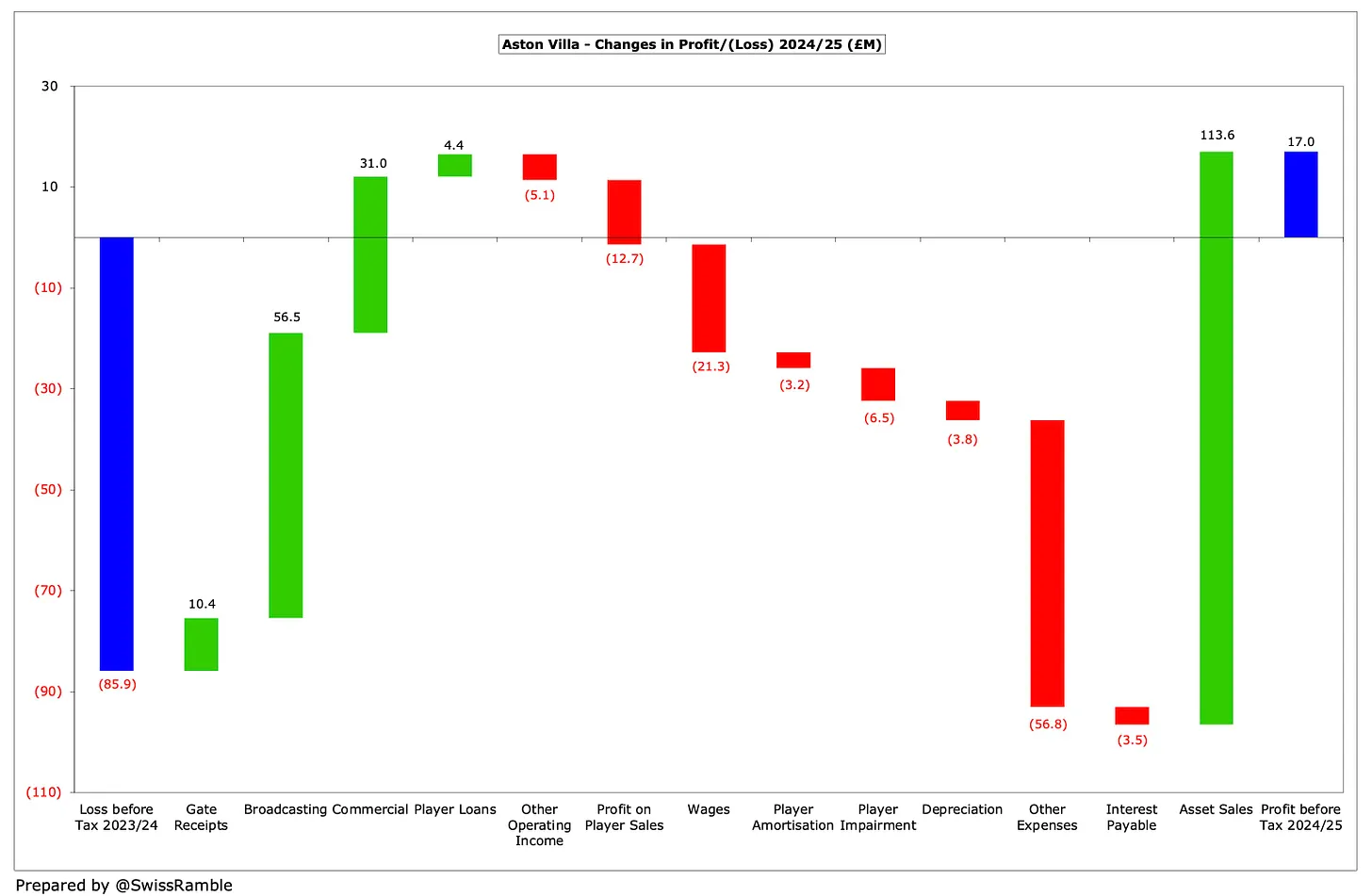
As per the accounts, things look pretty good, as Villa swung from a £86m pre-tax loss to a £17m profit, with revenue shooting up £102m (37%) from £276m to a club record £378m, although profit on player sales fell by £13m (20%) from £65m to £52m.
This was offset by steep cost growth, as operating expenses rose £92m (22%) from £426m to £518m, while net interest payable was up £3.6m (66%) from £5.3m to £8.9m.
However, the year-on-year improvement was entirely due to the £114m profit they made on the disposal of a couple of investments to another group company, namely the women's team and the operating rights to The Warehouse property.
If those in-house asset sales were excluded, Villa's pre-tax loss would actually have increased by £11m (12%) from £86m to £97m.
Furthermore, the operating loss was still a substantial £140m, only slightly better than the previous year's £145m.
All three main revenue streams set new club records, mainly thanks to more success on the pitch, including participation in the Champions League.
Broadcasting was the star of the show, rising £57m (31%) from £184m to £241m, but there was also good growth in the other revenue streams. Commercial increased by £31m (52%) from £60m to £91m, while gate receipts rose £10m (37%) from £28m to £38m.
In addition, player loans more than doubled from £3.5m to £7.9m, although there was no repeat of the prior year's £5.1m other operating income.
Villa's wage bill increased £21m (8%) from £252m to £273m, while player amortization also rose £3m (3%) from £97m to £100m and the club booked £6.5m player impairment.
In addition, depreciation was up £4m (62%) from £6m to £10m, while there was a significant increase in other expenses, which emerged £57m (80%) from £71m to £128m.
On paper, Villa's £17m profit was the second best result in the Premier League last season, only surpassed by Newcastle United's £35m, but the reality is that both clubs were significantly boosted by asset sales.